
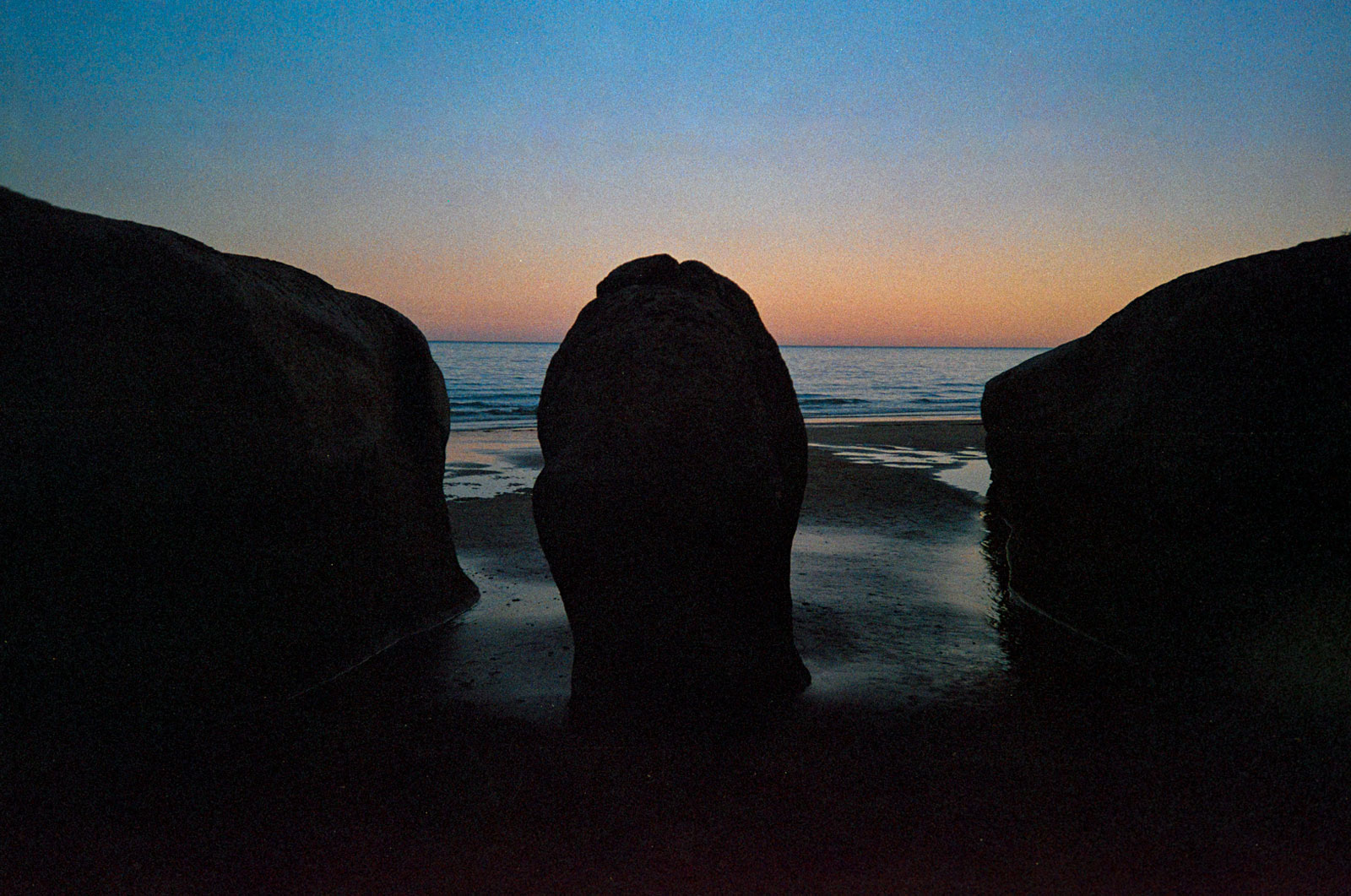
Escaping Nemesis in Menouthis, by Uriel Quesada
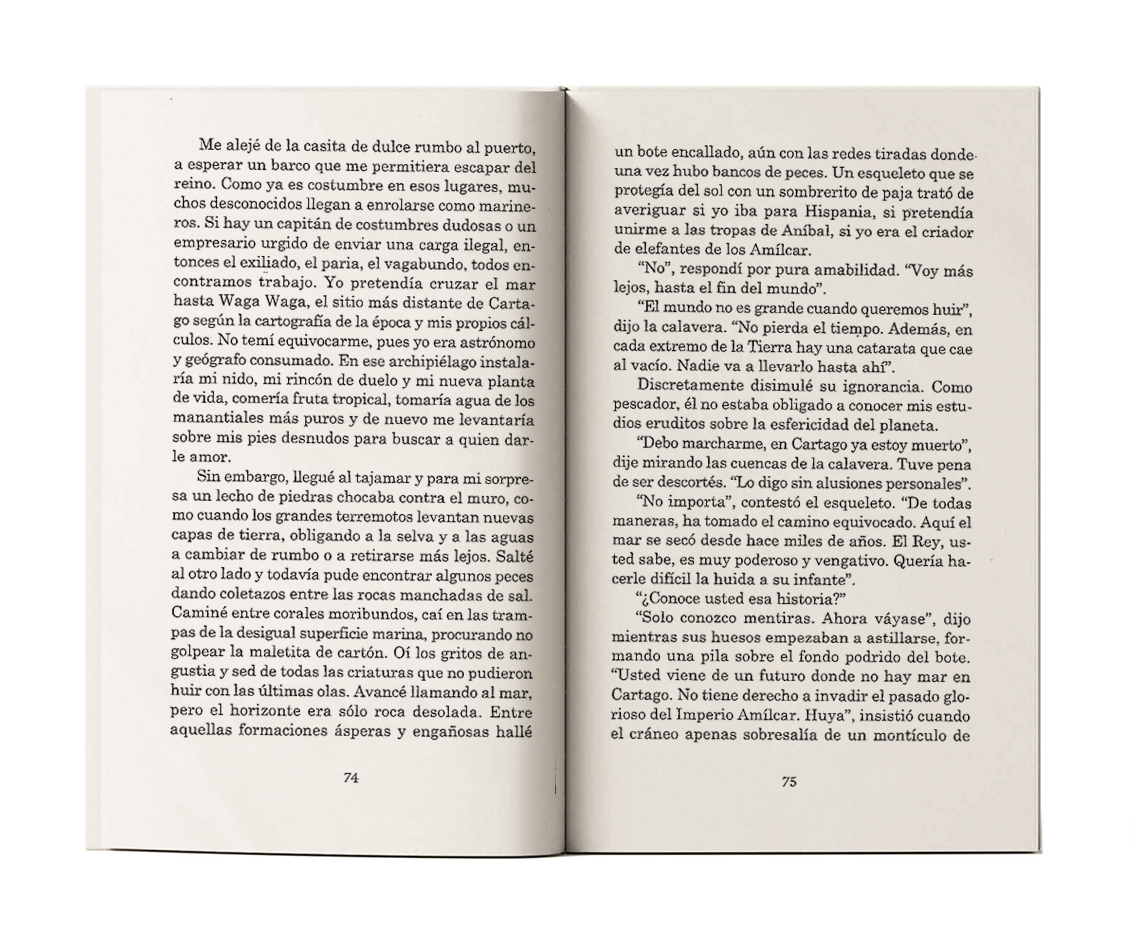
I tiptoed toward the harbor in search of a boat to carry me away from the kingdom. It is the custom in seaports for outcasts to turn up, hoping to sign on as sailors. Just find a captain of dubious personal habits, a businessman with pressing need to ship illegal cargo, and voilà. Exiles, pariahs, tramps: any or all may find ourselves hired. My goal was to cross to Wagga Wagga, the furthest possible point from Carthage on period maps and by my calculations. A consummate astronomer and cartographer, how could I err? In some mournful corner of that far archipelago I would build my little nest, my new set-up: savor tropical fruits, sip from crystalline springs, and bounce back on my two bare feet to find someone to love.
However.
I reached the seawall expecting surf. Only a stony seabed roiled there, exactly as if an earthquake had heaved up hidden strata and forced the sea to change course. A few fish flopped despairingly between briny rocks. Over the wall, I picked my way among dead coral, stumbling in sinkholes, always taking care not to scuff my little cardboard suitcase. Creatures abandoned by the last retreating waves gasped in anguish. I went on, calling to the ocean, seeing nothing but desolate rock to the horizon. Among jutting stones that looked like anything except what they were, I found a beached boat, its nets extended where schools of fish lately swam. A skeleton, brow shaded by a little straw hat, asked was I was bound for Hispania? Did I wish to join up under Hannibal? Was I an elephant herder for the Hamilcar Barca family?
“No,” I said, to be friendly. “My destination is further—the ends of the Earth.”
“When you’re on the lam, the Earth isn’t very big,” said the skeleton. “Don’t waste your time! Anyway, both ends just have waterfalls into emptiness. No one’s going to take you there.”
I tactfully ignored such rank ignorance. This simple fisherman could not know my own recent, highly erudite studies of our planet’s spherical nature.
“I must leave. Here in Carthage, I’m as good as dead,” I said, looking him straight in the empty sockets. Then, with a qualm, “not that I intend allusions of a personal nature!”
“No offense taken,” said the skeleton. “Anyway, you’ve come to the wrong place. The sea dried up here thousands of years ago. Our king, as you know, is mighty as well as vengeful. He made sure it would be hard for the Infante to flee.”
“Do you know that story?”
“I only know a pack of lies. Be off with you,” he said, as his bones began splintering into a little heap on the rotted planks lining his boat. “You come from the future, when Carthage has already lost its seaport. You’ve got a nerve, to bust into the glorious empire of General Hamilcar. Get a move on!” he urged. The skull was now barely visible in the pile of powdery bones. “Don’t hang around to be wiped out by History.”
A breeze blew off the salty horizon. The folds of ocean-bottom seemed to ripple. Suddenly, abysses between rock formations, hulls of wrecked galleons, pillared avenues of cities sunk by earthquakes, polished innards of conch shells, octopus’s caves—every single thing once belonging to the sea flooded with water again. A huge pelican lifted from shore and glided overhead, ready to plummet for a fish. My shoes filled up. Should I run for the far-off shore or accept my sad end? Water was lapping at my knees, sea creatures were nibbling, when I thought to climb into my interlocutor’s boat. But its hull split at my touch. The lonely skeleton sank among his nets, leaving only bubbles.
Unwilling to drown, I opened my suitcase and hopped in. It was a squeeze to wedge myself between the cardboard sides. From one zippered pocket I tugged an oar, from another the whitest sails ever seen. On the bottom lay cruise brochures for the Bahamas, a rudder, and nautical charts of the ancient Orient that showed quite a differently shaped world. Continents and islands long since lost appeared there, with the winds from plump deities puffing their cheeks on far shores. Hoisting sail, I set out to improve my luck. The current carried me to a bustling harbor, overhung with seagulls and crowded with peoples of strange customs. Tall ships waited to weigh anchor for unknown lands and treasures. Chains dragged by hundreds of suffering galley slaves clattered from the wharf. Little sphinxes gazed protectively seawards. Towering figures of Hercules, the goddess Isis, and Serapis marked the harbor entrance.
Reaching terra firma, I stowed my navigational instruments in the suitcase and set off down cobblestone streets. Men and women wearing tunics and espadrilles gazed curiously as I attempted every known language. At last one merchant answered my salutation, opening the pearly curtain to his shop.
I had reached Menouthis, he said: harbor to every pleasure and peccadillo, a port giving Alexandria the Glorious access to the sea. Did the traveler want lovely goods to slake longings back in his hometown, located no doubt in the region of Carthage? Was his kingdom overrun by the cruel Romans and their henchpersons, the Christians? Did he perhaps seek lissome youths to stir his appetites? Would he try his prowess at athletic games? Learn algebra and geometry with venerable Theon, or study with that sage’s lovely daughter Hypatia?
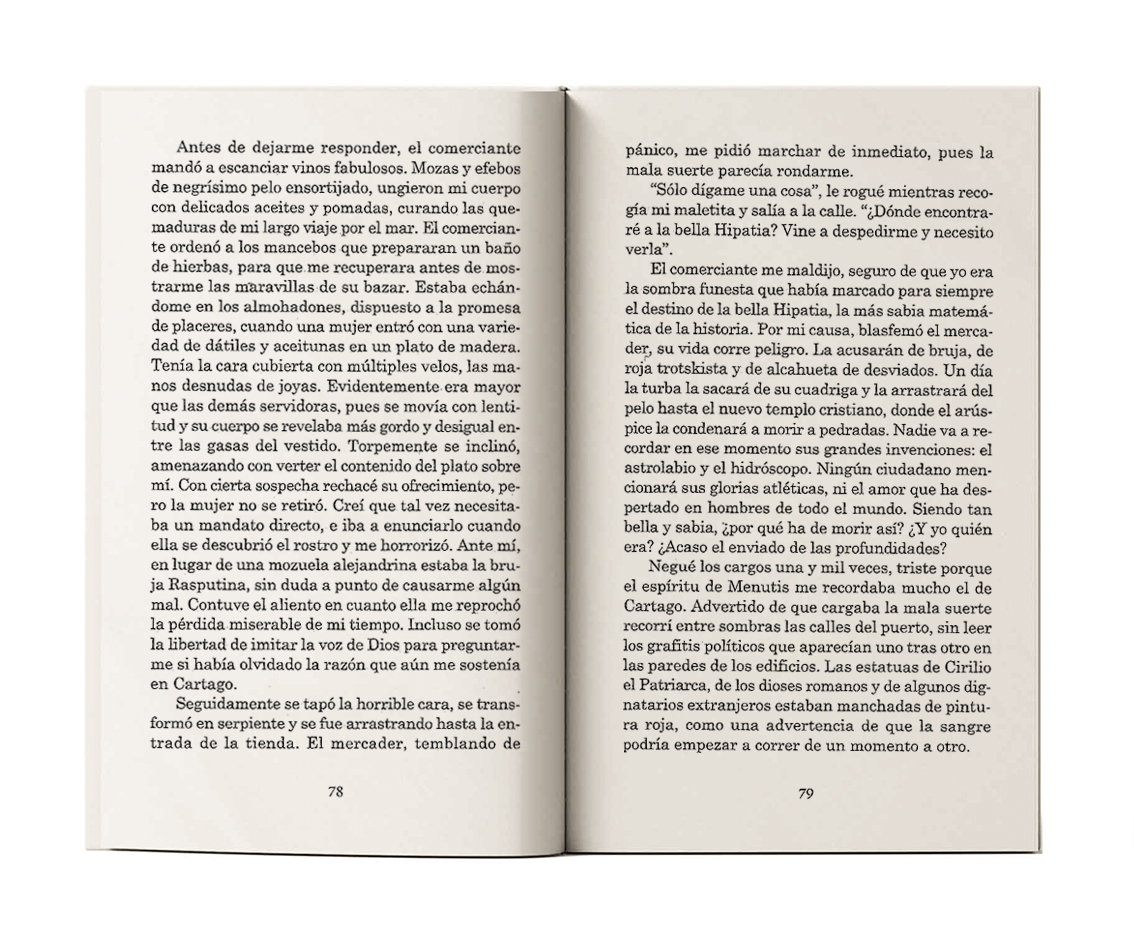
Before I could answer, he called for fabulous wines to be uncorked. Serving-girls and ephebes with jet-black ringlets anointed my body with oils and pomades, soothing the burns from my days at sea. The merchant ordered young men to draw an herbal bath, to refresh me before I viewed his marvelous bazaar. I had just tossed myself on fat cushions, ready for pleasures, when a woman entered bearing dates and olives on a wooden platter. Veils hid her face, and no jewels adorned her fingers. She had to be on the older side, because she moved stiffly and her body showed plump and lumpy through her gauzy tunic. She bowed awkwardly, nearly tipping the platter in my lap. With suspicion dawning, I waved it away. I was about to give a curt command when, to my horror, she bared her face. Before me knelt no Alexandrian maiden, but the witch Rasputina, traitorous servant, my old nanny! She could be up to no good. I held my breath while she scolded me for miserably wasting time. Brazenly, she produced the voice of God, no less: had I returned to Carthage only to abandon it, along with the last shred of common sense?
Then she masked her hideous face, turned into a snake, and slithered out the door. Trembling, the merchant begged me to be off—bad fortune clearly pursued me.
“Tell me one thing,” I begged, lifting my little suitcase and turning toward the street. “Where can I find the beautiful Hypatia? I come to bid farewell, and I must see her.”
The merchant cursed, certain I was one more sinister shadow darkening the destiny of the philosopher, most learned mathematician of all times. I would put her at risk, he swore.
“They’ll denounce her as a witch, a Trotskyite, a procuress to the wayward. Any day now the mob will haul her from the quadriga and drag her by her hair to that new Christian temple, where a soothsayer will condemn her to death by stoning. No one will recall her greatest inventions, the astrolabe and hydroscope. Not one citizen will know her athletic prowess or the love she inspired in people the world over. So beautiful and wise, why should she die like that?”
And anyway, who was I, he further inquired. An envoy, perhaps, from the depths below?
I denied all this a thousand and one times, stricken to see that even divine Menouthis was exactly like Carthage in spirit. Knowing now that bad luck was dogging me, I hurried down shady streets without stopping to read the political graffiti on building after building. Statues of Cyril the Patriarch, of Roman gods, and of foreign dignitaries dripped red paint, as if warning that blood could flow at any moment.
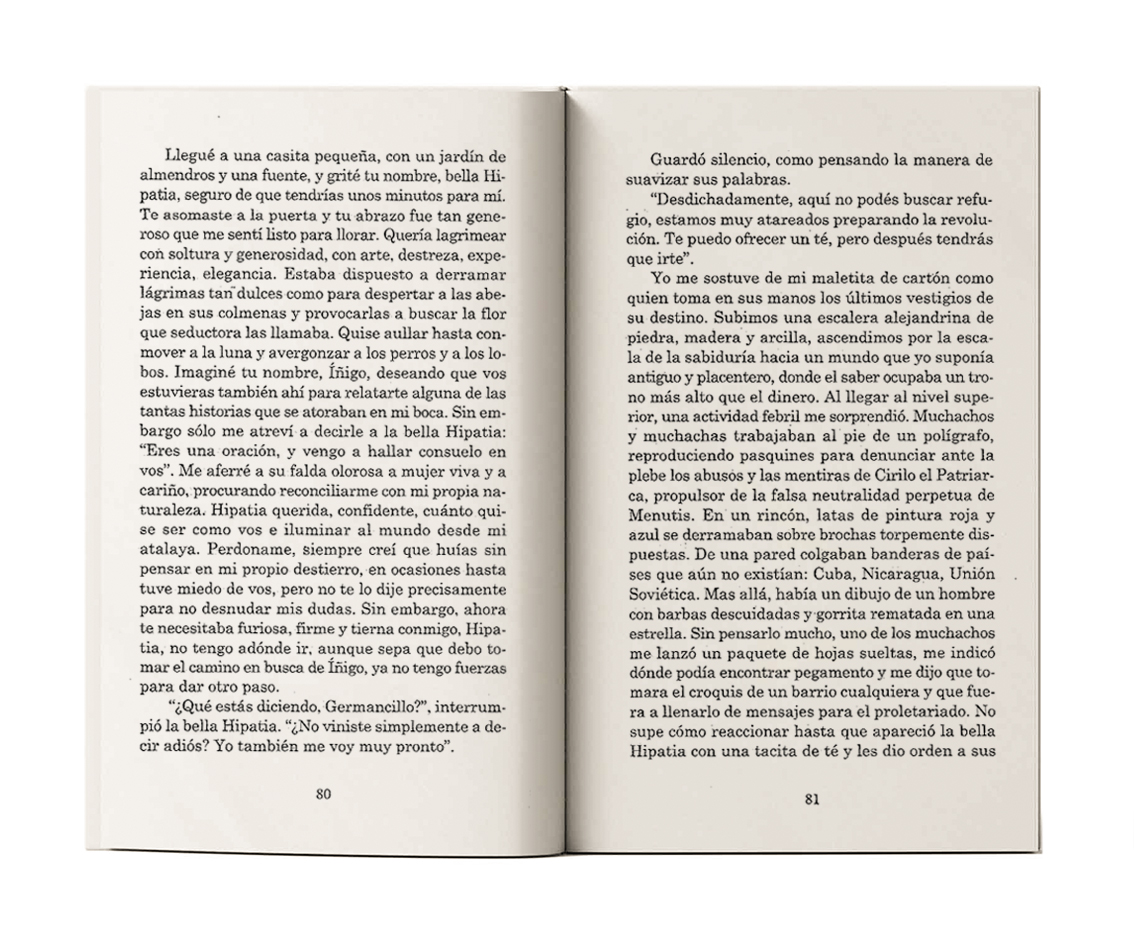
Reaching a little house set among almond trees with a fountain, I shouted the name of lovely Hypatia, sure she would spare me a few minutes. She opened the door, and her generous embrace brought tears to my eyes. I wanted to weep artfully, skillfully, with ease and fluency, elegance and experience. I was ready for tears so sweet they’d wake up bees in the hives and rouse them to seek each seductive flower. I wanted to howl, putting dogs and wolves to shame, until the moon stirred with pity. I thought your name, O beloved Iñigo, and wished you were there so that I could tell you every story choking my mouth.
But to the beautiful Hypatia I dared only say, “You are a prayer, and I come seeking consolation with you.” Clinging to her robe with its scent of a woman, of tenderness, I tried to reconcile myself to my nature. Darling Hypatia, confidante! How I wanted to be like you, enlightening the world from a tower. Forgive me; I always thought that you fled without thinking of my own exile. At times I even feared you, but I never told you so, not wanting to expose my doubts. But now I needed you—you, furious, firm, but with me always tender.
“Hypatia, I have nowhere to go. I should take to the roads in search of Iñigo, but I can’t move another step …”
“What do you mean, Hermie?” interrupted the lovely Hypatia. “Surely you’ve come to say good-bye? I’m leaving soon, too.” She paused, perhaps thinking how to soften her words. “I’m afraid I can’t hide you here. We’re as busy as can be, preparing for the revolution. I can offer you a cup of tea, but then you’ll have to go.”
I clutched my suitcase like one clutching the last shreds of destiny. We began climbing an Alexandrian staircase of stone, wood, and clay, ascending the ladder of wisdom toward a world I pictured as ancient, full of pleasures, where Knowledge sat enthroned high above money. But the feverish activity at the top astonished me. Around a mimeo machine, young people ran off flyers with unsigned accusations alerting people to the abuses and lies of Cyril the Patriarch, sponsor of the so-called Perpetual Neutrality of Menouthis. In a corner, cans of red and blue paint slopped out over a welter of brushes. One wall sported flags of nations that had not yet come into existence: Cuba, Nicaragua, the Soviet Union. Further on was a drawing of a man with a messy beard and star-topped cap. With no warning a boy tossed me a sheaf of flyers, pointed to the wheat-paste glue, and ordered me to grab a scrawled map of any old neighborhood so I could plaster it with communiqués for the proletariat. How was I to react?
The lovely Hypatia reappeared with a cup of tea for me and told the comrades to lay off: I was just dropping by on my way out of town. They could trust me. I wouldn’t squeal to the authorities.
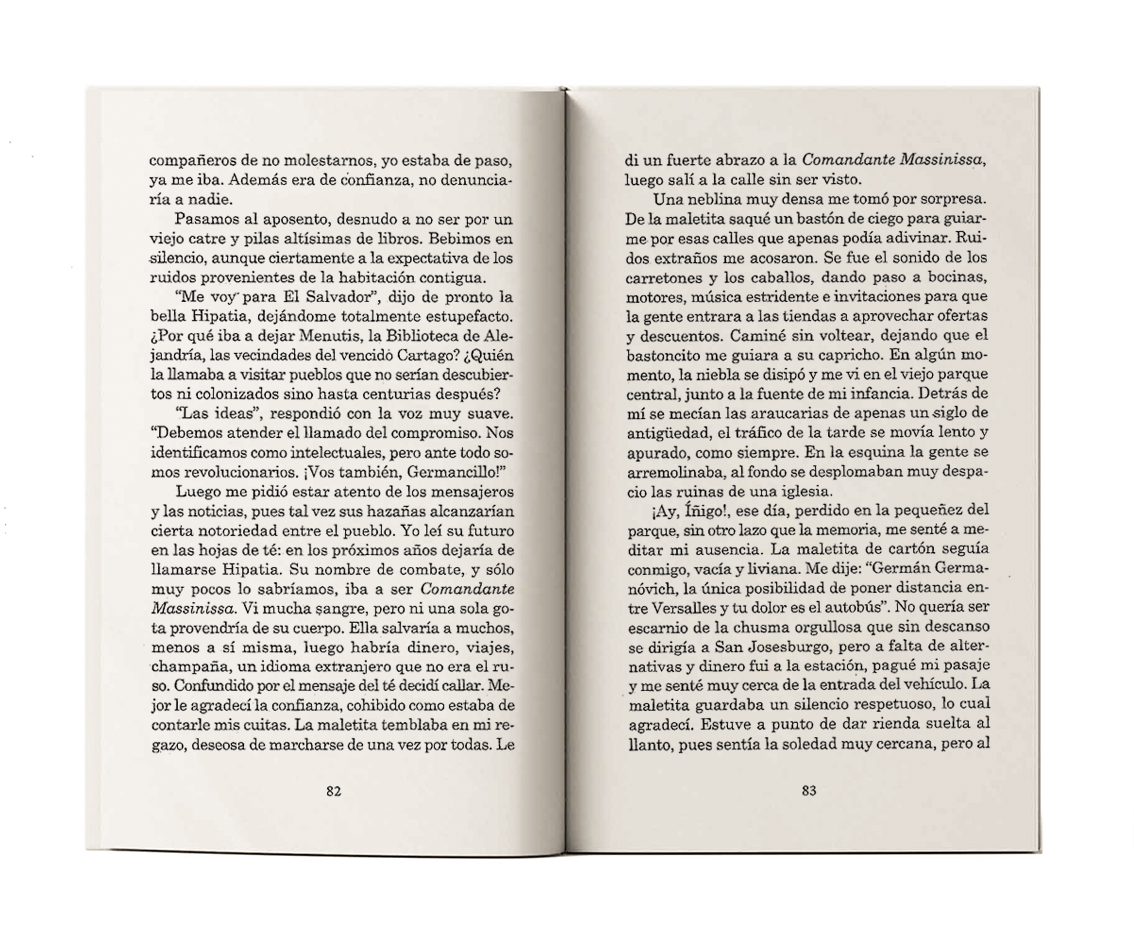
“I’m headed for El Salvador,” announced Hypatia, which stupefied me. Why would she leave Menouthis, or the Library of Alexandria, these outskirts of the vanquished Carthage? Who summoned her to visit peoples who would not be discovered or colonized for many centuries to come?
“The ideal forms!” she answered mildly. “We must heed the summons to commitment. We call ourselves intellectuals, but above all we are revolutionaries. You too, Hermie!” She told me to stay alert for messengers and listen for news, because her derring-do might win popular renown.
In our tea leaves, I read her future: she would drop the Hypatia. Her nom de guerre, known to few, would be Commandante Massinissa. The leaves showed much blood, but not one drop shed from her body. She would save many lives, but not her own. Then came money, travel, champagne, and a foreign language—but not Russian. Confused by what the teacup had to say, I held my tongue. It seemed best simply to thank her for confiding in me, since I felt barred from sharing my own tale of woe. The little suitcase trembled in my lap, anxious to get going. I briskly embraced Commandante Massinissa, then stepped into the street without being observed.
There, a heavy fog awaited. From my suitcase I pulled a blind man’s cane, to guide me down streets I could only guess at. Strange noises assaulted me. Carts and horses gave way to klaxons, combustion engines, strident music, and invitations into particular shops for very special offers and discounts. Without looking back, I let my cane direct me where it wished. When that fog cleared, I found myself back in the old downtown park of Carthage, near the fountain of my childhood days. Overhead swayed araucaria trees less than a century old; as always, the afternoon traffic moved slowly and impatiently. People milled about on the corner. In the background, a ruined basilica toppled very, very, very slowly.
Oh, my dear Iñigo! That day, adrift in the tiny park, with no ties but memory, I sat down to ponder my own absence. The cardboard suitcase was still at my side, carefree now and empty.
“Hermann Hermannovitch,” I told myself, “the only way to put distance between your childhood home and your sorrowing heart is by bus.” I had no wish to be laughed at by the proud rabble endlessly climbing on board for Saint Josephsburg, but for lack of options (or cash for that matter), I went to the station, paid the fare, got on, and took a seat near the door. The little suitcase maintained a respectful silence, for which I was grateful. I was on the verge of tears, feeling loneliness draw near, but sensing danger of just that kind, the driver jerked his thumb at a notice: “No Eating, No Drinking, And No Weeping Whatsoever On This Bus!”
I restrained myself. Seeking a bit of comfort, I tried chatting with the passenger next to me, but again the driver warned, “no sad stories!”
I sighed—for doing so fewer than three times was not forbidden. Then I bid a silent goodbye to the city without waving, afraid to break any more rules.
© Uriel Quesada, El gato de sí mismo.
Editorial Costa Rica, 2005.

Date
May 7, 2025